Kesla narrows losses and raises guidance as forestry equipment demand remains weak
Kesla’s third-quarter net sales increased by 26.4%, while its operating loss narrowed significantly. Defence deliveries supported growth, and crane demand in Finland showed signs of improvement. However, demand for harvesting equipment and tractor-mounted forestry equipment remained subdued.

Kesla’s net sales for July–September rose to EUR 9.3 million from EUR 7.3 million a year earlier. Its operating loss narrowed to EUR 250,000, compared with a loss of approximately EUR 1.35 million in the corresponding period. EBITDA turned slightly positive.
The company also raised the lower limits of its full-year guidance. Kesla now expects 2026 net sales of EUR 43–45 million and an operating result of 0–2% of net sales. Previously, it forecast net sales of EUR 38–45 million and an operating result ranging from −2% to +2%. The guidance assumes that the operating environment remains stable.
According to CEO Pasi Nieminen, the company’s turnaround measures are beginning to improve its financial performance.
“Turnaround measures are delivering results, but work to restore profitability to the targeted level continues,” Nieminen says.

Defence deliveries support growth
Kesla’s Defence business continued to perform strongly in the third quarter. Deliveries under the major Kerberos order announced in March progressed as planned, supporting both net sales and production capacity utilisation.
Third-quarter order intake reached EUR 9.3 million, up 60.5% year on year. At the end of September, the order book stood at EUR 23.9 million, approximately three times the level recorded a year earlier. The Defence business accounted for around EUR 12.9 million of the total.
Kesla continues to develop its defence product offering and pursue international sales. However, the company notes that defence procurement involves multiple stages and can take a long time.
Crane demand in Finland shows signs of improvement
Demand for truck and industrial cranes showed tentative signs of recovery, particularly in Finland. Customer activity increased after the summer, and industry trade fairs supported sales and orders. International market conditions remained challenging.
There was no significant recovery in demand for harvesting equipment. Uncertainty in the forest machine market continued to affect Kesla’s OEM customers, while demand for separately sold harvester heads also remained weak.
In Europe, the main market for Kesla’s tractor-mounted forestry equipment, customers remained cautious about investing in loaders and forest trailers. Market conditions showed no material improvement during the quarter.
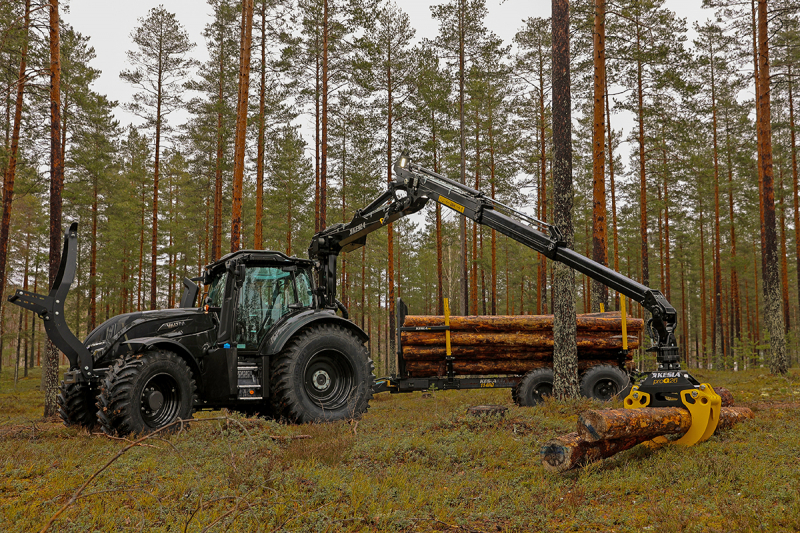
Kesla introduced several products during the autumn. Launches at FinnMETKO included the new 2212–2217 truck-mounted crane range, harvester head models designed for small-diameter timber, the proG60 timber grapple and the 145 forest trailer.
Sale process for tractor equipment business continues
The sale process for Kesla’s tractor equipment business, launched in the spring, was still ongoing at the end of September. No binding agreement had been signed, and the company is continuing the process during the autumn.
Kesla aims to focus its resources on businesses offering the strongest potential for profitable growth. It is also restructuring its costs and production operations and continuing to improve operational efficiency.

Cash flow strengthens over the first nine months
In January–September, Kesla’s net sales increased by 9.8% to EUR 29.2 million. Its operating loss narrowed to EUR 825,000 from approximately EUR 2.6 million a year earlier.
Cash flow from operating activities strengthened to EUR 4.6 million, compared with EUR 0.3 million in the corresponding period. Interest-bearing net debt fell from EUR 11.4 million to EUR 6.1 million. However, the equity ratio declined from 31.3% to 25.7%.
Financing uncertainties remain. Kesla’s bridge financing is due for repayment by the end of the year, and the company is discussing compliance with year-end loan covenants with its lenders.
According to Nieminen, the stronger order book provides a better foundation for Kesla’s turnaround. Nevertheless, the company remains cautious about the market outlook and expects uncertainty in the operating environment to continue.